Slitting or cut to length: how to know which one your process needs
Two services that sound alike and solve different problems. The rule fits in one question: does your machine eat sheet, or does it eat coil?
Almost every week a request comes in that says "I need to cut sheet metal" and nothing else. It is a perfectly reasonable request, but it is not enough to quote, because a service center cuts in two very different ways and each one delivers a different product.
The fast way to decide is to look at the machine that will receive the material, not at the material itself.
The question that settles 90 % of cases
Is your equipment fed with loose sheets, or from a continuous coil?
- If somebody places sheet after sheet in the press, or if the material goes into a press brake, a laser cutter or a work table, you need cut to length.
- If your equipment has an uncoiler and pulls material without stopping — progressive die, roll former, tube mill, strapping line — you need slitting.
Everything else (gauge, material, finish) matters just as much for the quote, but it does not change which of the two services you are asking for.
What a cut-to-length line actually does
The coil arrives with two vices inherited from rolling and coiling: curvature memory and edge wave. Memory is the material's tendency to curl back up; edge wave is the result of the coil's edges having stretched differently from its center.
A leveler attacks both at once. The material crosses a train of rolls that bends it alternately up and down, with a penetration that keeps decreasing. Each bend takes the steel fibers past their elastic limit, so that by the exit they no longer remember which side they were coiled on. At the end of the line, the shear cuts to the programmed length.
What comes out is a flat, square, stable sheet. And that stability pays for itself downstream:
- The die receives material that will not spring open or twist when released.
- The feeder does not jam on a bowed sheet.
- Formed parts repeat their dimension from the first to the last of the lot.
- Welding does not fight gaps that appear because the sheet will not sit flat.
If your part comes out of the press fine but deforms afterwards, check sheet flatness before you touch the die. The tooling is often not the culprit.
What a slitting line actually does
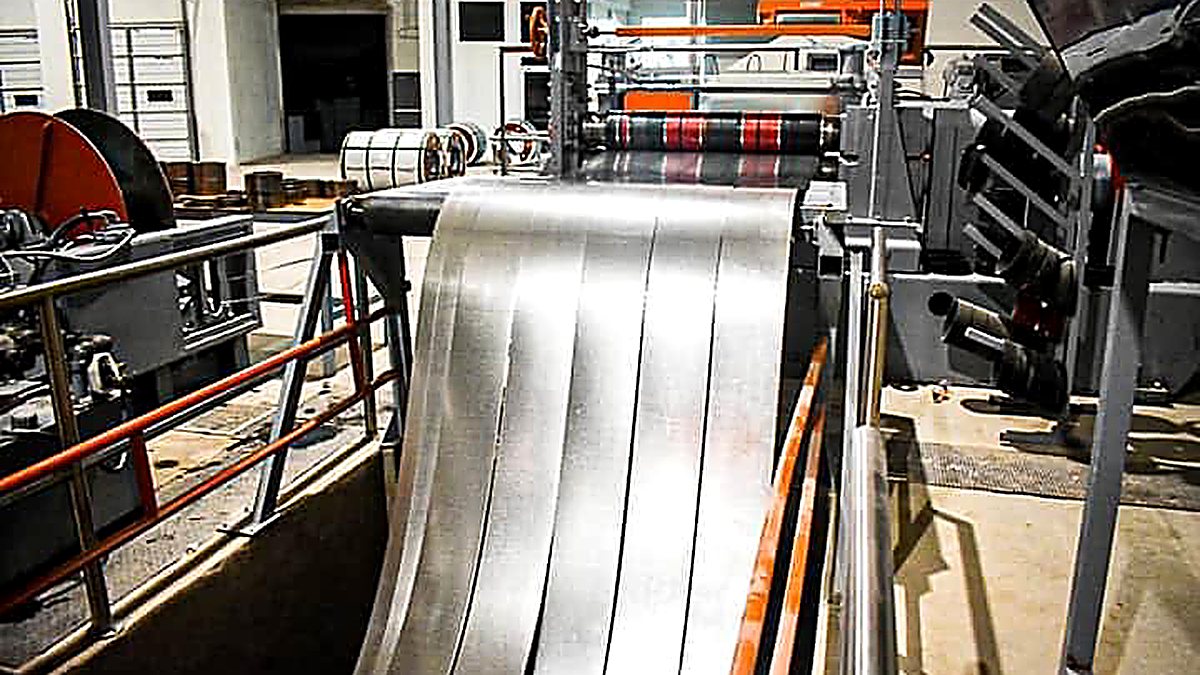
In slitting the coil never stops being a coil. It is uncoiled, crosses a set of circular knives mounted on two arbors, and is rewound as several narrower strips, each at its own width.
The knives do not cut by brute pressure: they shear, and the clearance between the upper and lower knife is what decides whether the cut comes out clean or leaves burr. That clearance is set by thickness and by material. A 0.5 mm steel and a 3 mm steel do not take the same clearance, and stainless does not take the same clearance as galvanized at the same gauge.
There are two defects to watch closely:
Burr
Burr is the small lip of material left on the edge when clearance is excessive or the knife is already worn. You can feel it with a gloved finger, and it brings three consequences: it is a cut hazard for the operator, it wears downstream tooling, and it gets in the way of welding and coating, because a sharp point will not hold paint.
Telescoping
This is when the rewound coil shifts sideways and the wraps come out stepped, like a telescope. It happens when rewinding tension is uneven or when strip separation is not properly shimmed. A telescoped coil does not feed well: it binds in the customer's uncoiler and the first wraps have to be scrapped.
When the answer is "both"
It is more common than it sounds. An enclosure manufacturer may need flat sheet for the covers and narrow strip for the reinforcements that come off a roll former. If both cuts are requested in the same material and gauge, running them in the same plant has an advantage that is not in the price: the coil is used better, because the leftover from one width can become the other product instead of becoming scrap.
What to send with your quote request
With these six items a firm quote goes out without a round trip:
- Material and coating (GI, EG, CR, HR, aluminum, stainless).
- Thickness in millimeters or gauge.
- Coil entry width, if you already have it.
- Output size: strip width, or sheet width and length.
- Quantity, in pieces, tons or coils.
- The date you need it at your plant.
If one of them is missing, send it anyway. A quote with a stated assumption beats a week lost waiting for the complete data.
Need a quote for a cut like this? Send us material, gauge and size.
Request a quote