GI, EG, CR and HR: which steel to order for each application
Four abbreviations that get mixed up constantly, and that decide whether your part lasts ten years or rusts through its first rainy season.
On a sheet metal purchase order, changing two letters changes the material, the price and the service life of the part. These are the four carbon steel families most often requested at a service center, what actually separates them and where each one belongs.
HR — Hot rolled
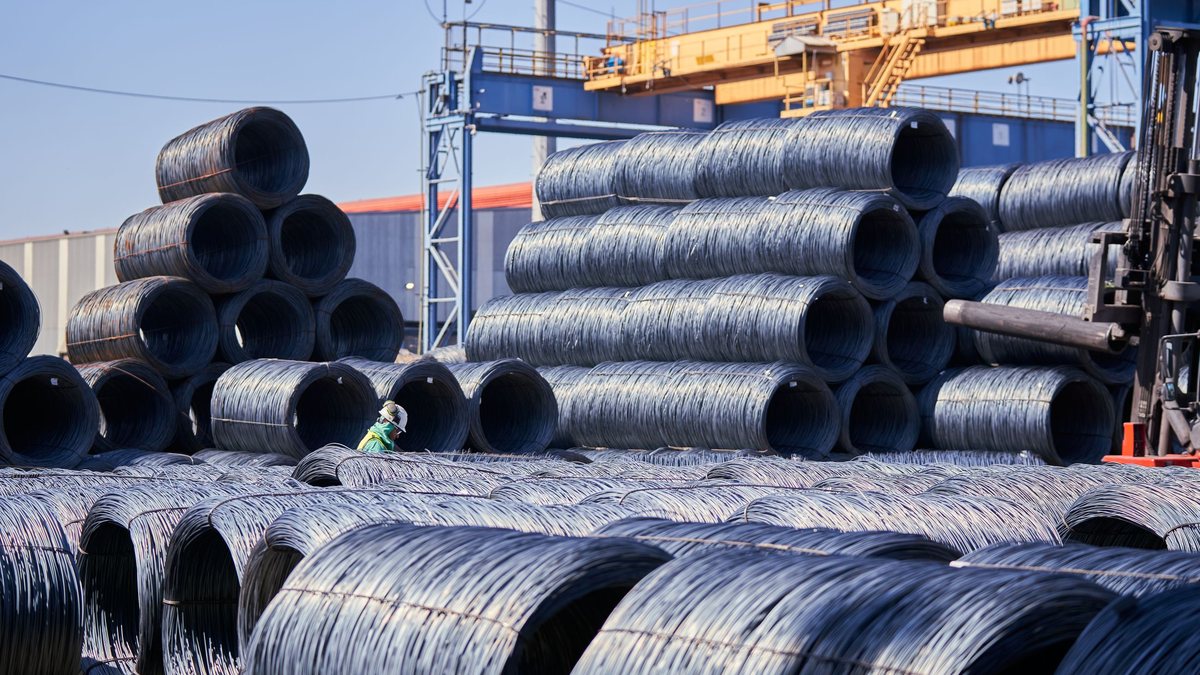
Rolled above the steel's recrystallization temperature. That allows a large thickness reduction with little energy, but it leaves a surface with mill scale and a looser dimensional tolerance.
- Where it fits: structure, bases, reinforcements, brackets, thick parts that will later be painted or hot-dip galvanized.
- Where it does not: any visible part with no downstream finish, or anywhere thickness has to repeat point to point.
- Watch out: if you will paint or weld it, specify pickled and oiled. Mill scale ruins adhesion and dirties the weld pool.
CR — Cold rolled
This is HR that gets pickled and rolled again cold. Cold deformation tightens tolerance, smooths the surface and work-hardens the material; it is then annealed to bring ductility back.
- Where it fits: deep drawing, heavily formed parts, surfaces that will be painted, anything that needs a tight tolerance.
- Where it does not: humid environments without protection. Bare CR rusts fast.
- Watch out: the protective oil it ships with. If your paint or adhesive process has no degreasing step, you will have adhesion problems.
GI — Hot-dip galvanized
The sheet passes through a molten zinc bath. The resulting layer is thick and bonds metallurgically to the steel, forming intermediate zinc-iron alloy layers.
What matters about zinc is not that it covers the steel: it is that it protects it cathodically. Zinc corrodes before steel does, so even on a cut edge, where the steel is exposed, the surrounding zinc keeps protecting that edge. That is why GI takes a cut without needing the edge touched up.
- Where it fits: duct and HVAC equipment, outdoor enclosures, roofing and façades, anything that lives with moisture.
- Where it does not: surfaces where a perfectly smooth finish is wanted with no preparation, because of the zinc spangle texture.
- Watch out: coating weight is specified by designation (G60, G90 or the equivalent in grams per square meter). Ordering "galvanized" with no designation means letting price decide for you.
EG — Electro-galvanized
Here zinc is deposited electrolytically, not by immersion. The layer is much thinner and perfectly uniform, and the surface comes out smooth.
- Where it fits: parts that get painted and seen, appliance interiors, electronics chassis, panels. It is the favorite when the paint has to look flawless.
- Where it does not: outdoors without paint. The layer is so thin that unpainted outdoor protection is short-lived.
- Watch out: confusing it with GI on the order. Outdoors, the corrosion resistance gap between the two is measured in years.
The mental decision table
If it had to be reduced to four rules:
- Outdoors or humid, with no reliable paint? → GI.
- Painted, and the finish shows? → EG, or CR if it gets a robust coating.
- Heavily formed, tight tolerance, controlled environment? → CR.
- Structural, thick, and strength is what matters? → HR.
Aluminum and stainless: when the jump is worth it
Beyond carbon steel, two materials solve problems carbon steel cannot.
Aluminum weighs about a third of what steel weighs and produces no red rust. It is the answer when weight matters or when heat dissipation matters. Its cost per kilo is higher, but per part it is sometimes not that different. It scratches very easily: ask for separators and edge protection.
Stainless steel is for hygiene, severe corrosion and permanent appearance. Its big trap at a service center is cross contamination: if it runs with the same tooling as carbon steel, iron particles embed in the surface and later appear as rust spots. A supplier who tells you how stainless handling is kept separate is telling you something important.
Before you send the order
A sheet metal order that generates no questions carries, at minimum: family (GI, EG, CR, HR, aluminum, stainless), coating designation where it applies, thickness in millimeters, output size, quantity and date. With that, the quote goes out on the first pass and the material arrives being the one you had in mind.
Need a quote for a cut like this? Send us material, gauge and size.
Request a quote